
The short answer
If your furnace blows cool air, turns on and off every few minutes, makes new noises, or won't ignite, it likely needs repair. TotalFlow finds the cause, explains your options, and gets your approval before any work begins. Most furnace problems can be repaired, and Bay Area Air District rules don't require you to replace a working furnace.
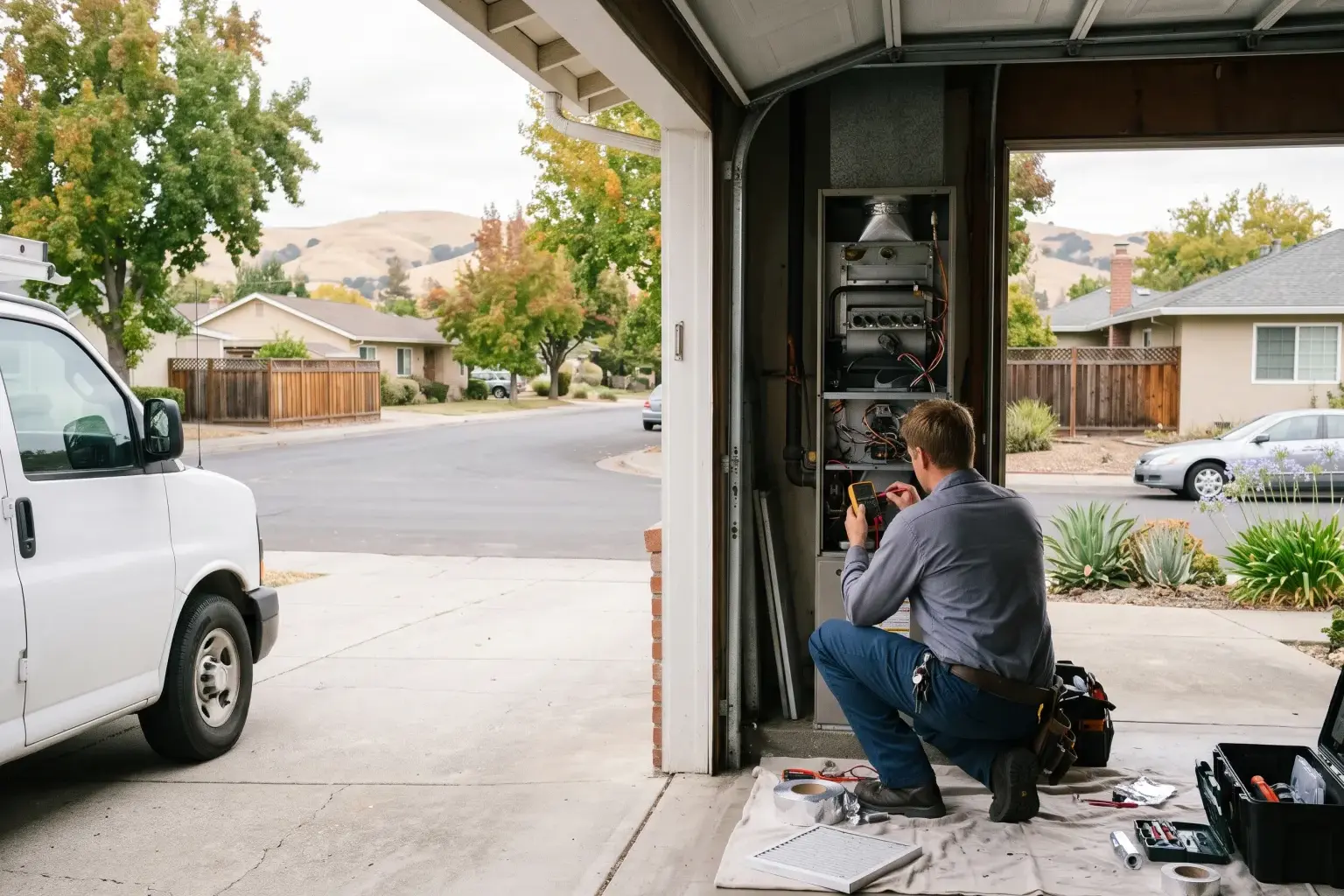
When your furnace stops heating, short-cycles, or starts making noises it never used to, you want a clear answer about what's wrong and what it will take to fix it. TotalFlow HVAC Repair Service repairs furnaces for homeowners in Livermore, Pleasanton, Dublin, San Ramon, and nearby Tri-Valley cities. Our technicians diagnose gas furnaces, check safety components, and explain what they find in plain language before any work starts. This page covers the warning signs to watch for, what a repair visit includes, and how to think about repairing versus replacing an older unit.
Signs Your Furnace Needs Repair
Tri-Valley winters are mild compared to much of the country, but cold nights are common from late fall into early spring, and many homes rely on a gas furnace to get through them. Furnace problems often start small. Catching them early can mean a simpler repair and less chance of losing heat on a cold night.
If you smell gas, leave the house and call your gas utility or 911 from outside. If a carbon monoxide alarm goes off, get everyone out and call for help before you call us. Don't try to restart the furnace in either case.
- No heat, or air from the vents that feels lukewarm instead of warm
- The furnace turns on and off every few minutes (short-cycling)
- Some rooms stay cold while others are comfortable
- Banging, rattling, squealing, or scraping sounds when the blower or burners start
- A burning smell that lingers well past the first few minutes of the heating season
- The igniter clicks repeatedly or the burners won't stay lit
- The thermostat calls for heat but nothing happens
- Higher gas bills without any change in how you use the system
- A yellow or flickering burner flame instead of a steady blue one
What We Check During a Furnace Repair Visit
A good repair starts with a full diagnosis, not a guess. Our technician will run the system and work through the components most likely to cause the symptoms you describe. A typical check includes:
Safety comes first. If we find a problem that could let combustion gases into your living space, such as a cracked heat exchanger or a blocked vent, we'll explain the risk and may recommend keeping the furnace off until it's fixed.
- Thermostat settings, wiring, and communication with the furnace
- Air filter condition and airflow through the return and supply ducts
- Igniter or pilot assembly and flame sensor
- Gas valve operation and burner condition
- Heat exchanger, inspected for cracks, corrosion, or signs of overheating
- Inducer motor, pressure switch, and venting for proper draft
- Blower motor, capacitor, and blower wheel or belt condition
- Limit switches, rollout switches, and other safety controls
- Control board error codes and electrical connections
- Condensate drain and trap on high-efficiency furnaces
Repair or Replace Your Furnace?
Most furnace problems can be repaired. A failed igniter, dirty flame sensor, bad capacitor, or faulty pressure switch is usually a straightforward fix. Replacement becomes worth discussing when the furnace is older, needs a major part like a heat exchanger or control board, has needed several repairs in recent years, or no longer keeps the house comfortable.
We'll give you our honest take on both paths. Some questions worth weighing:
Local rules matter too. Under Bay Area Air District Rule 9-4, natural gas furnaces manufactured starting in 2029 must meet a zero-NOx emission standard. In practice, that points homeowners toward heat pumps when a furnace is replaced after that date. The rule does not require you to replace a furnace that's working; it applies only when an existing furnace fails or is replaced. If your furnace can be repaired, repairing it is a perfectly reasonable choice.
If you're considering a heat pump, check BayREN and your local clean energy provider for current electrification incentives. Amounts and availability change by funding cycle, so we confirm the current offer before including it in any quote. Keep in mind that the federal Energy Efficient Home Improvement Credit covered qualifying heat pumps placed in service before December 31, 2025, and isn't available for new installations now.
- How old is the furnace, and how much useful life is it likely to have left?
- Is the needed part still available for your model?
- Has the system needed repeated service calls?
- Would you also like central air conditioning, which a heat pump can provide?
What Affects the Cost of Furnace Repair
We can't price a repair until we know what's wrong, but these factors drive the final cost:
Before any work begins, we'll explain what we found and what we recommend, and nothing moves forward until you approve it.
- Which part failed, and whether it's a common item or a manufacturer-specific component
- The furnace's age, brand, and model, which affect part availability
- Where the unit is installed: attics, crawl spaces, and tight closets take more time to work in
- Whether more than one component needs attention
- Timing, such as evening, weekend, or holiday visits
- Related issues found during diagnosis, like duct leaks or venting problems
How a Furnace Repair Visit Works
Here's what to expect when you schedule with us:
To help us diagnose faster, clear the area around the furnace, and note when the problem started and whether it happens every time the heat runs.
- Tell us what's happening: the symptoms, any error codes or sounds, and roughly how old the furnace is.
- We schedule a visit and let you know when the technician is on the way.
- The technician diagnoses the system and walks you through the findings.
- You get a clear recommendation and decide how you'd like to proceed.
- Once you approve, we complete the repair, often during the same visit when the part is on hand.
- We test the furnace through a full heating cycle and confirm it's running safely.
Furnace Repair by city
- Furnace Repair in PleasantonLocal service & repairs
- Furnace Repair in DublinLocal service & repairs
- Furnace Repair in San RamonLocal service & repairs
- Furnace Repair in DanvilleLocal service & repairs
- Furnace Repair in Union CityLocal service & repairs
- Furnace Repair in FremontLocal service & repairs
- Furnace Repair in BrentwoodLocal service & repairs
- Furnace Repair in HaywardLocal service & repairs
- Furnace Repair in NewarkLocal service & repairs
- Furnace Repair in MilpitasLocal service & repairs
- Furnace Repair in TracyLocal service & repairs
- Furnace Repair in ClaytonLocal service & repairs